My parents had episodes on VHS and I watched them until the tapes wore thin. Kirk and Spock on alien worlds. McCoy arguing with both of them. A bridge crew that looked like the future was worth getting to. When Next Generation came along, I watched it live every week with my family. Deep Space Nine after that. Voyager when it aired.
What hooked me was never the technobabble or the phaser fights, though I liked those fine. It was the premise underneath everything. Humanity made it. We built ships and went out there and found things we didn’t expect. The aliens we met forced us to confront who we are. The best episodes asked a question the crew couldn’t answer easily, and the audience had to sit with it after the credits rolled.
That’s what science fiction is supposed to do.
When I started writing my own fiction, I kept circling back to that premise. Not the Federation specifically, not warp drives and transporters, but the bones of it. What happens when two civilizations that fought a war have to learn to work together? What does first contact look like when the stakes are real and nobody has a universal translator to smooth over the hard parts?
The Stars Entwined was where I started pulling that thread. Lieutenant Sean Barrows goes undercover on an Aryshan starship during a war between humanity and an alien civilization. He’s there to gather intelligence. What he finds instead is that the enemy isn’t what either side has been told. The Aryshans have their own culture, their own loyalties, their own way of seeing the galaxy, and none of it maps neatly onto human assumptions.
That book came from every Trek episode where the supposed villain turned out to be more complicated than the briefing suggested. Where the real threat was misunderstanding, not malice. I wanted to write a first contact story where the contact itself was the plot, where two species had to figure each other out under pressure with lives on the line.
The Aryshan War trilogy continued that story through a full-scale conflict and its aftermath. Three books of humans and Aryshans fighting, negotiating, betraying, and slowly learning that survival meant something different than either side assumed. By the end of that trilogy, the war is over. The two civilizations are working together. Ships carry mixed crews.
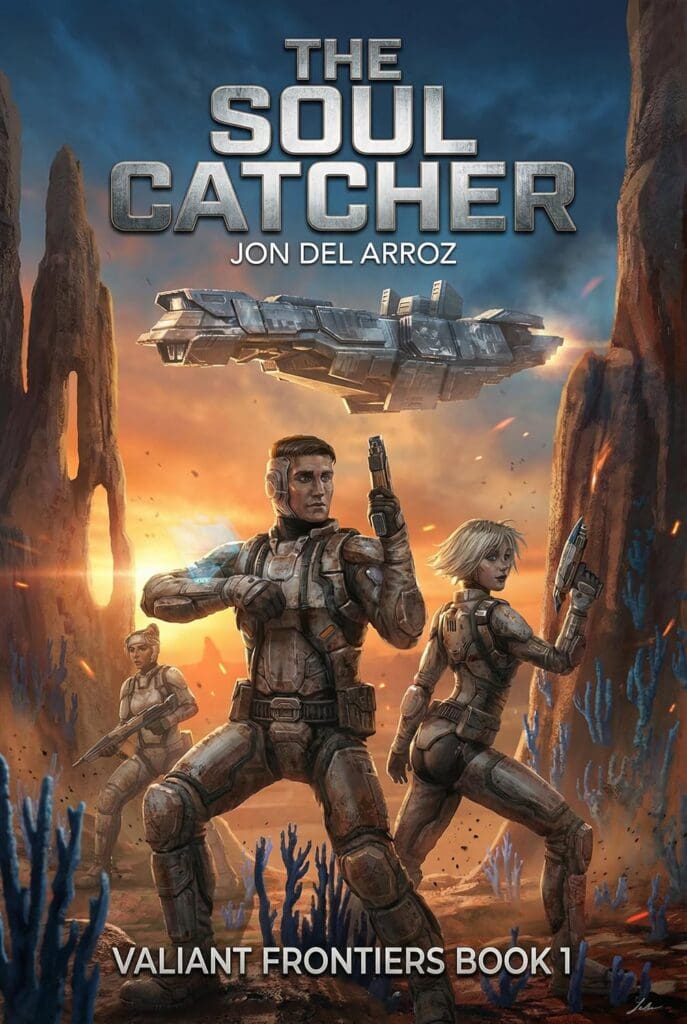
And that’s where Valiant Frontiers begins.
The E.A.S. Valiant has a human and Aryshan crew serving together. Captain Conley leads them into uncharted space. Commander Selah, Troy Robinson, Lt. Verelan, Dr. Morgana, Lt. Kelim. A bridge crew that looks like the future these two civilizations built together after almost destroying each other.
This is the series I always wanted to write.
Not the war. Not the espionage. The part that comes after. A starship crew heading into the unknown because that’s what civilizations do when they stop fighting and start looking outward. First contact with new species. Mysteries that don’t have clean answers. A crew that trusts each other because they earned that trust through everything that came before.
The Soul Catcher, Book 1 of Valiant Frontiers, opens with a cameo that fans of the original trilogy will recognize and love. I won’t spoil it. But it ties the old story to the new one in a way that felt right the moment I wrote it.
There’s a saboteur on board the Valiant. There are alien civilizations nobody has encountered before. There’s a discovery that forces impossible choices. And across all three books of the trilogy, there are questions that the crew can’t answer easily, the kind of questions the audience has to sit with after the last page.
That’s what I loved about Trek. That’s what I wanted to put on the page. Not a copy of someone else’s universe, but the same impulse that made Gene Roddenberry point a camera at a bridge crew and say: what if we made it? What if we went out there? What would we find?
Classic science fiction used to ask those questions every week. Big ideas explored through characters you cared about on ships you wanted to serve on. Somewhere along the way, most of the genre stopped doing that. The franchise that inspired me has struggled with it for years. The publishers who used to put out books like this are chasing other markets.
So I wrote the books I wanted to read.
The Soul Catcher is out now on Amazon and Kindle Unlimited. If you love Star Trek the way I do, if you miss what science fiction used to feel like, this is where you start. The full Valiant Frontiers trilogy is available, and the Stars Entwined and Aryshan War books that started it all are there waiting if you want to go back to the beginning.
Start with The Soul Catcher: https://amzn.to/4ecGDyN

Leave a Reply